Stand in any Madeiran supermarket and you mostly see food that has travelled: fruit from mainland Europe and beyond, grains from overseas, packaged products from all directions. For a small Atlantic island, this is normal – but it is also a quiet reminder of how dependent Madeira has become on ships and supply chains we do not control.
Regional commentators estimate that Madeira now imports well over 80% of the food it consumes – a striking figure for a place whose terraces, levadas and volcanic soils have supported agriculture for centuries. In a world of climate shocks and geopolitical tension, that dependence is no longer just an economic question; it is about food security.
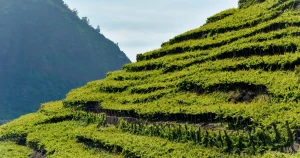
An Island of Terraces – And Imports
Agriculture still matters here more than many visitors realise. Around a quarter of Madeirans are involved in some form of farming, often on steep, terraced slopes irrigated by levadas. The island’s utilised agricultural area reached roughly 4,703 hectares in 2023, even as the total number of holdings fell by nearly 10% between 2019 and 2023 – a sign that smaller farms are struggling to survive.
Recent figures published in The Portugal News show potatoes leading temporary crops at over 17,000 tonnes in 2024, followed by sugarcane and sweet potatoes. Bananas remain iconic, with roughly 25,000 tonnes harvested. Plant production accounts for more than 80% of agricultural output, particularly vegetables and subtropical fruit. And yet, Caniçal’s port still handles more than a million tonnes of cargo a year, about 88% of it imports, including a large share of what ends up on our plates.
Portugal, overall, is structurally dependent on food imports, especially for cereals and processed products. A recent analysis of 186 countries found that only one – Guyana – produces enough food in every major category to feed itself without imports. Most nations, including Portugal, fall short in several groups. True self‑sufficiency is the exception, not the norm.
The “How Many Days?” Question
People often ask: if ships stopped tomorrow, how long could Madeira feed itself? It is a powerful question, but there is no simple answer.
Since 2022, Madeira has maintained a strategic wheat reserve of around 4,300 tonnes, enough to supply at least two months of cereal for bread making if imports were interrupted. Local crops – potatoes, sweet potatoes, seasonal vegetables, bananas – would stretch that further, but they are not yet grown at a scale and diversity that could replace all the imported foods we take for granted.
No public authority has published a definitive “days of autonomy” figure for the full diet, and any precise number would depend on rationing and expectations. What we do know is that Madeira has some resilience – in its terraces, its growers and its grain stock – but also a deep dependence on external supply for a modern, varied diet.
What Breakfasts on the Island Reveals
So what does this have to do with an all‑day vegetarian breakfast in central Funchal?
Look at a typical hotel buffet and you see a compact map of global dependency: anonymous cereals, eggs and dairy of unclear origin, fruit that may have travelled farther than many guests. In a region that imports most of its food, breakfast becomes the most visible place where provenance quietly disappears.
NUA was created as a different kind of table – an all‑day, unlimited vegetarian breakfast that starts from local fields rather than purely from a wholesaler’s catalogue. The goal is not to erase imports; coffee and certain grains will most likely always travel. The question is: plate by plate, what could be grown closer to home, in this climate, by producers whose names we actually know?
As Damien, NUA’s owner, puts it:
“If ninety per cent of your breakfast table is anonymous, you’re missing an opportunity. We wanted guests to be able to point at a dish and say: ” This is from that valley, from that grower, in this season. It changes how you eat – and how you value the island.”
Growing for a Restaurant That Cares
For farmers, selling to a restaurant that genuinely values provenance feels very different from selling into a commodity market. When a kitchen commits to buying local greens, roots and fruit every week – and is willing to adapt the menu to the harvest – it creates something different, a dignified demand.
In Madeira, where many holdings are tiny and labour‑intensive, those relationships can be the difference between keeping land in production or letting it slide towards abandonment. The data already show fewer, slightly larger farms – a sign that the smallest are disappearing. Restaurants can either accelerate that trend, by prioritising anonymous imports, or soften it, by designing menus around what small producers do best.
At NUA, that means starting with what growers can actually supply in a given season – more sweet potatoes when they are at their peak, more pimpinela when a farmer has a surplus, a spotlight on a particular leaf because a small producer has perfected it this year. The menu becomes a snapshot of what is possible in Madeira now, not an abstract ideal borrowed from somewhere else. As Damien puts it:
“If we want growers to take risks – plant new varieties, convert fields, invest in better practices – we have to meet them halfway. That means long‑term relationships, fair prices, and a menu that doesn’t panic when the weather changes. And if you are a local farmer, we want to hear from you!”
A Small, Practical Form of Food Leadership
No single restaurant will solve Madeira’s import dependence. But every time a kitchen chooses local potatoes over imported ones, celebrates bananas and subtropical fruits grown a few kilometres away, or builds a dish around a heritage ingredient, it nudges the system in a different direction.
The point is not to chase an impossible ideal of total self‑sufficiency. The real opportunity is to identify where Madeira can realistically grow more of its own food, and to turn those possibilities into dishes that guests actively seek out. Tourism, in that sense, can either be a pressure – more demand for imported convenience – or a lever for resilience, if visitors are invited to taste the difference that local makes.
At NUA, the all‑day vegetarian breakfast is designed first for pleasure: generous, abundant, easy to linger over. Beneath that, it is also a quiet proposal for the island’s future. What if more of our tables – in hotels, cafés, homes – were built around what this land can actually grow, in this climate, with these people?
The question “How many days could Madeira survive without outside food?” is not there to alarm, but to sharpen our attention. Food security is not decided only in government plans or port statistics. It is written, every day, in what we plant, what we buy, and what we choose to serve for breakfast.