
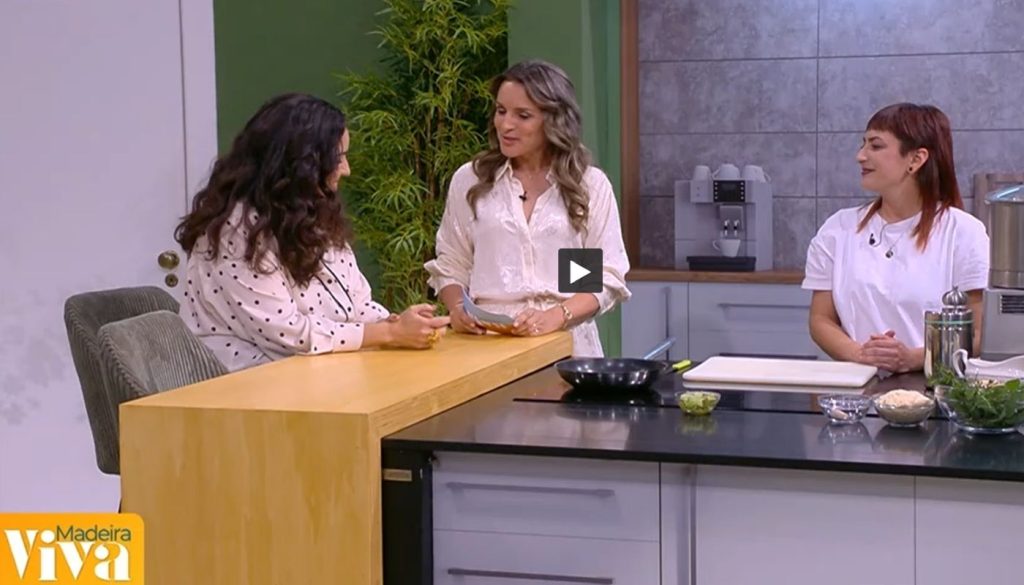
Just one month into opening our doors, NUA stepped into the kitchen of Madeira Viva on RTP Madeira — and brought a bunch of chayote (“pimpinela”) along for the ride.
The segment gave us the chance to do what we love most: talk honestly about why we cook the way we cook, share where our ingredients come from, and show that Madeiran produce, long underestimated and often reduced to a supporting role, can hold the spotlight entirely on its own.
NUA founder Luísa Mendonça joined presenter Isabel Gomes alongside chef Valentina to demonstrate live, in front of the cameras, the dish that has already become something of a signature for us: a silky pimpinela and sweet potato velouté, seasoned with rosemary, sage and onion, finished with toasted almond flour and our homemade dehydrated loquat.
“Pimpinela is like that distant cousin at a wedding who only shows up out of obligation. We wanted to give it a seat at the head of the table.“
Luísa Mendonça, Founder of NUA
A Restaurant Without a Menu
NUA was born from a simple but radical idea: what if the land decided what we cook, rather than the other way around?
Most restaurants build a menu first, then go searching for the suppliers who can fill it. At NUA, we do the opposite. We call our farmers, predominantly organic growers across Madeira, and ask what the earth gave this week. The menu writes itself from there.
That means if you visit twice in the same week, you will have two entirely different experiences. Same kitchen, same philosophy, but different produce, different combinations, different plates. It is not a limitation; it is the point.
As Luísa explained on air:
“The flavours are always changing. The way we prepare the food is always changing, always with the care to bring out the maximum from whatever agricultural products are available.“
01
Farmer First
We work directly with local producers, predominantly organic. No intermediaries, no compromise on provenance. If you grow it biologically on this island, we want to hear from you.
02
No Fixed Menu
Our dishes evolve day to day based on what the land provides. Every visit is a different encounter. Same values, new flavours.
03
Improbable Pairings
We don’t fear failure in the kitchen. Our creative process is one of experimentation — crossing flavours that shouldn’t work together until they do.
04
Plant-based Abundance
We do not make a virtue of restriction. We make a virtue of creativity and abundance. Our kitchen team approaches vegetables, legumes, grains, and dairy with the same curiosity a fine dining kitchen might apply to any ingredient — because we believe this is how plant-based food earns its place at the table.
The pimpinela that appeared on Madeira Viva was brought in fresh from Camacha: organic, in season, and ready for its long-overdue close-up.
And a note for any organic farmers reading this: Luísa extended an open invitation live on air. If you grow biologically on this island and want to work with us, reach out. It would be a pleasure.
Pimpinela & Sweet Potato Velouté with Toasted Almond & Dehydrated Loquat
2
portionsAllergens: None of the 14 EU allergens.
Ratio: 3 parts pimpinela to 1 part sweet potato.
Servings: Serves 2 as a main, 4 as a starter.
Ingredients
Pimpinela — fresh, in season (ideally from Camacha)
Sweet potato — 1 for every 3 pimpinela
Almond milk — organic preferred; cow’s milk works too
Almond flour — or whole toasted almonds blended to flour
Garlic — for the aromatic base
Rosemary — fresh sprig
Thyme — for the aromatic base
Sage — 1 to 2 leaves only (it is powerful)
Dehydrated loquat (nêspera) — for garnish and depth
Seeds — of your choice, for texture
Quality olive oil — Portuguese, always
Salt — just a touch, at the end
Directions
- Cook the vegetables
Place the pimpinela and the sweet potato in a pot with plain water — no salt, no oil, the flavour will come later from the aromatic oil. Bring to a gentle boil and cook for 20 to 30 minutes, until both are fully soft and yielding. Drain and set aside. - Remove the water from the pimpinela
This step is what separates a velouté from a soup. Pimpinela holds a great deal of water, and you need to draw it out before blending — otherwise the result will be too thin.
You have two options. Option A: wrap the cooked pimpinela in a linen cloth (the kind used for making cheese or nut milk) and squeeze firmly to press out the liquid. Option B: place the pimpinela in a dry frying pan — no butter, no oil — over medium heat and stir continuously for 2 to 3 minutes until the excess moisture evaporates. Do not let it colour or crust. - Make the aromatic oil infusion
In a separate pan, warm a generous pour of quality olive oil over a gentle heat. Add the garlic (sliced or lightly crushed), the thyme, a sprig of rosemary, and one or two sage leaves. Allow the herbs to slowly release their essential oils into the olive oil without frying — you are looking for a fragrant, golden infusion, not a sizzling sauté.
The sage is subtle but important: it adds a prolonged floral note that lifts the whole dish. Use restraint — one or two leaves is enough. - Blend to a velouté
Combine the dried pimpinela, the cooked sweet potato, the aromatic oil infusion (herbs strained or left in, as you prefer), and enough almond milk to bring everything together into a smooth, velvety consistency. Blend until completely silky. Add a pinch of salt to taste. Adjust the milk quantity to achieve the thickness you prefer — slightly thicker for a main course, a little more liquid for a starter portion. - Finish and serve
Ladle into warm bowls. Garnish with a scattering of almond flour (or freshly toasted, blended almond), pieces of dehydrated loquat (we’ll be publishing our very own recipe soon, so stay tuned!), and seeds of your choice. A final drizzle of olive oil is optional but welcome.
Notes
- Free from all 14 EU allergens
Final Thought
Pimpinella, Reinvented
For Luísa, this recipe captures something she has believed for a long time: that the ingredients most familiar to us — the ones we grew up seeing on every table — are often the ones most deserving of a second look.
Pimpinela has always been here, quietly present in Madeiran cooking, tucked into stews and broths without much ceremony. The goal was never to reinvent it, but to see it clearly — and to let its flavour, when properly supported, speak for itself.
That is what NUA is, in a sentence: paying attention to what has always been here, and treating it with the care it deserves.
Try the recipe at home, come visit us in Funchal, or both. And if you grow organically on this island — reach out. The door is open.